
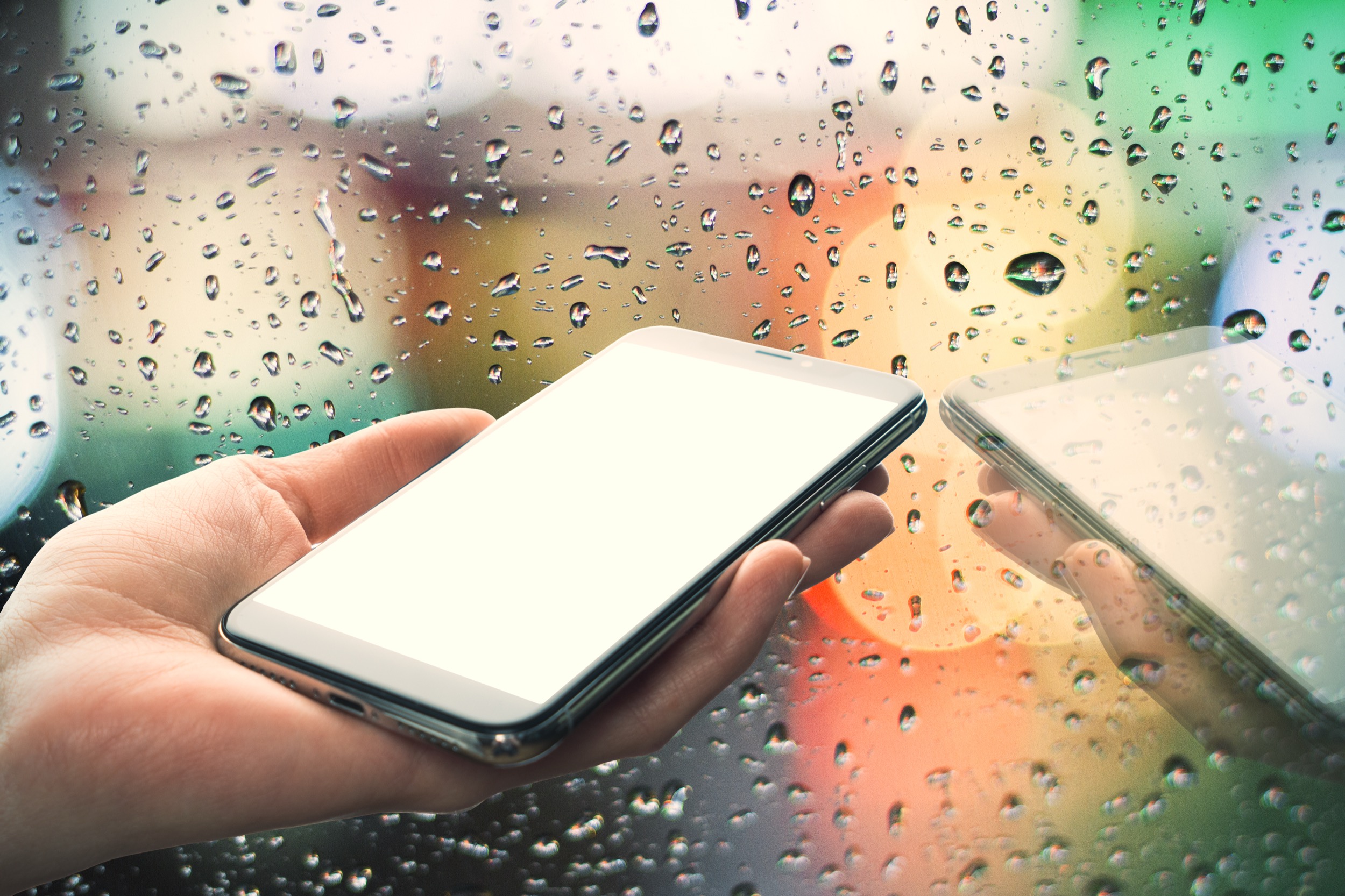
If you've noticed your mobile signal dipping during a downpour, you're not imagining it. Rain can and does affect mobile signal strength. But rain alone is rarely the whole story. In most commercial environments, weather-related dropouts are a symptom of a signal that was already marginal. The rain just pushes it over the edge.
This article explains how rain and other weather conditions affect your mobile phone signal, why the real problem is usually the building rather than the weather, and what businesses can do to fix it.
How Rain Affects Mobile Signal Strength
Mobile signals travel as radio waves between your device and the nearest cell tower. Rain introduces moisture into that path, and water absorbs and scatters radio frequency energy. This reduces the strength of the signal by the time it reaches your device.
This effect is known as rain attenuation, and it becomes more pronounced at higher frequencies. That matters because modern 4G and 5G networks increasingly rely on higher-frequency bands to deliver faster data speeds, and those bands are more susceptible to interference from rain.
In practical terms, rain attenuation can cause slower data speeds, reduced call quality, intermittent dropouts, and weaker signal strength across the coverage area. The heavier the rainfall, the more noticeable the impact.
Other Weather Conditions That Affect Your Signal
Rain gets most of the attention, but it's not the only weather condition that interferes with mobile connectivity.
Humidity and fog introduce atmospheric moisture in a similar way to rain, though typically with a milder effect. In tropical or coastal parts of Australia, persistent humidity can contribute to gradual signal degradation that's easy to overlook until it compounds with other factors.
Thunderstorms and lightning present a different kind of risk. Electrical interference from storm activity can disrupt the radio frequency environment temporarily, causing signal instability during and immediately after a storm.
Extreme heat also plays a role. High temperatures affect atmospheric density, which influences how radio waves propagate between the tower and your device. In parts of Australia where summer temperatures regularly exceed 40°C, this is a recurring factor rather than an edge case.
Wind doesn't directly interfere with radio waves, but it can cause physical damage to antennas and cell tower infrastructure, leading to localised network outages.
Why Weather Exposes the Root Cause
Here's where it gets relevant for businesses. In most commercial buildings, the mobile signal indoors is already weaker than it is outside. Building materials like reinforced concrete, steel framing, metal roofing, and energy-efficient Low-E glass all reduce the signal before it reaches the people and devices inside.
When you add rain attenuation on top of that existing signal loss, the connection drops below the threshold needed to maintain reliable performance. The weather is the trigger, but the underlying cause is inadequate in-building coverage.
This plays out in predictable ways. A retail site where EFTPOS terminals rely on mobile data to process transactions will see payment failures during heavy rain if the baseline indoor signal is already borderline. A warehouse running mobile-connected scanning and dispatch coordination loses operational continuity when a storm tips the signal from marginal to unusable. A multi-level commercial building with patchy coverage in stairwells and basement areas will see those dead zones expand during wet weather.
In each case, the weather didn't create the coverage gap. It revealed one that was already there.
This is why addressing weather-related signal issues in a business environment isn't about waiting for the rain to stop. It's about making sure the indoor signal has enough headroom to absorb the impact of weather without dropping out.
How In-Building Coverage Systems Solve This
In-building coverage (IBC) systems are designed to deliver a reliable mobile signal inside buildings where the external network can't reach effectively on its own. By strengthening the indoor signal, these systems build in a margin that keeps connectivity stable even when weather conditions reduce the signal coming from the nearest cell tower.
There are two main approaches.
-
Signal boosters capture an existing cell signal from outside the building using a donor antenna, amplify it, and redistribute it indoors through internal antennas. For smaller sites where the coverage issue is concentrated in specific areas, a signal booster can be a practical and cost-effective solution. The key requirement is that there's a usable signal available outside to work with. Signal boosters improve what's already there rather than creating a new signal.
-
Distributed Antenna Systems (DAS) are designed for larger or more complex environments. A DAS uses a network of indoor antennas connected to a central system to provide engineered coverage across a wide footprint. This is typically the better fit for multi-level buildings, large commercial facilities, shopping centres, hospitals, and industrial sites where coverage needs to be consistent across many zones.
In either case, the result is the same: the indoor signal is strengthened to the point where normal weather variations, including heavy rain, don't cause the connection to drop out.
Recommended Read: How to Boost Mobile Phone Signal for Australian Businesses
Compliance and Carrier Alignment in Australia
In Australia, signal boosting equipment must meet ACMA standards and comply with carrier requirements. Non-compliant or unauthorised equipment can interfere with the broader mobile network and create regulatory risk.
A properly designed IBC solution accounts for the signal environment outside the building, the construction and layout of the site, and the applicable carrier and compliance obligations. Getting this right from the start avoids interference issues and ensures the solution performs as intended.
What Should You Do If the Weather Is Affecting Your Signal?
If your team regularly experiences mobile signal issues during rain or storms, it's worth investigating the baseline coverage inside your building. A site audit will identify where the signal is weakest, what's causing the degradation, and which solution will deliver reliable results regardless of what's happening outside.
MobileCorp designs and delivers in-building mobile coverage solutions for Australian businesses. From site assessment through to installation and carrier alignment, we help organisations strengthen their indoor mobile signal so that weather conditions don't disrupt the connectivity your operations depend on.
Improve In-Building Mobile Coverage
FAQs
Does rain really affect mobile phone signals?
Yes. Rain introduces moisture into the atmosphere, which absorbs and scatters the radio waves that carry mobile signals between your phone and the nearest cell tower. The effect is more noticeable on higher-frequency bands, including those used by 5G networks, and during heavy or prolonged rainfall.
Why does my mobile signal get worse during storms?
Storms combine several factors that can degrade signal strength. Heavy rain causes attenuation, lightning creates electrical interference in the radio frequency environment, and wind can physically damage cell tower infrastructure. Together, these conditions can cause noticeable signal instability.
Can a signal booster help with weather-related mobile dropouts?
In many cases, yes. A signal booster amplifies the available outdoor signal and redistributes it indoors, which can provide enough margin to maintain a stable connection even when rain or other weather conditions reduce the incoming signal. For larger sites, a DAS may be more appropriate.
Is weather the main reason for poor mobile signals in my building?
Usually not. In most commercial buildings, the primary causes of poor indoor signals are building materials (concrete, steel, Low-E glass) and distance from the nearest cell tower. Weather can make an already marginal signal worse, but it's rarely the sole cause.
Do I need carrier approval to install a signal booster in Australia?
Yes. All signal boosting equipment in Australia must meet ACMA requirements and comply with carrier rules. Unauthorised installations can cause network interference and may result in penalties. A professional site assessment ensures the solution is compliant and fit for purpose.
Lorin McDowell 01 May 2026
Popular Tags
- Mobile Devices (80)
- Mobility (80)
- 5G (67)
- Telstra (64)
- MobileCorp Managed Services (53)
- Mobile Network (38)
- Networks (32)
- Cradlepoint (31)
- Apple (28)
- MobileCorp (28)
- iPhone (24)
- Remote Working (22)
- Network (18)
- Mobile Security (15)
- Wireless WAN (15)
- Covid-19 (14)
- UEM (14)
- Cyber Security (12)
- MDM (11)
- Mobile Expense Management (10)
- TEMs (9)
- Mobile Device Lifecycle (8)
- Mobile Device Management (8)
- Cloud (7)
- Unified Comms (7)
- Unified Communications (7)
- Wandera (7)
- Android (6)
- Sustainability (6)
- Data Networks (5)
- Network Security (5)
- Samsung (5)
- Security (5)
- Digital Experience (4)
- IOT (4)
- Microsoft Intune (4)
- Blog (3)
- Data (3)
- IT Services (3)
- Microsoft (3)
- DAS (2)
- Microsoft 365 & Teams (2)
- Retail (2)
- nbn (2)
- webinar (2)
- 4G (1)
- Distributed Antenna System (1)
- EMM (1)
- Emerging Technologies (1)
- Government (1)
- Hosted Telephony (1)
- In-Building Coverage (1)
- Managed Desktops (1)
- Nextivity (1)
- SD-WAN (1)
- Starlink (1)
- Telstra Services (1)
- WWAN (1)
- video (1)